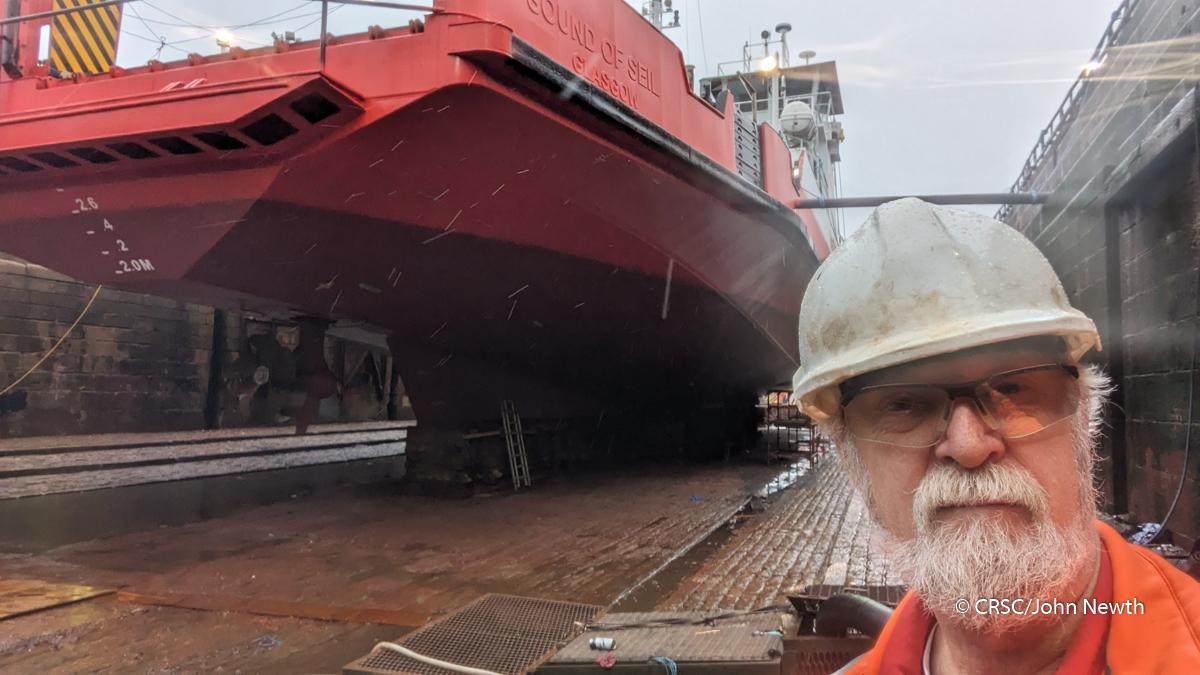
December’s stand-in speaker John Newth where else but a place he knows well – the bottom of a dry dock
There was a change of plan for the December CRSC meeting at Glasgow’s Maldron Hotel as Club President Gavin Stewart had to postpone his Presidential Address due to personal circumstances. So the committee asked Mr Reliable to provide an alternative presentation. Unfortunately Mr Reliable wasn’t able to attend either, and so John Newth very kindly stepped forward. His subject, Dry Dock, may have sounded somewhat like a medical condition, but in fact alluded to John’s career as a marine engineer. Here, Stuart Craig, gives an insight into the evening which turned out to be anything but dry – apart from the docks!
It is said that whenever you want something done urgently you should ask a ‘busy man, or woman’. John fits that bill (the former one!) for aside from his post-retiral domestic timetable, he has played, and continues to play, several active roles within the CRSC: website sub-committee member, Ferry News compiler, past-cruise convenor, past-Review editor, and general ship and ferry sage. And so he willingly stepped forward to enlighten his audience about the role that the dry dock plays in the annual agenda of every passenger ship.
John started the show by showing us the various types of dry dock that he has encountered, from the Clyde to Southampton, to Japan and India. He included alternative ways of removing ships from the water, such as cradles and cranes. He simplified the role such docks play by listing the reasons why ships are scheduled to enter one of these each year: maintenance, repair, survey and alteration (MRSA if you like). In a quite fascinating array of images he showed examples of each being undertaken, from viewpoints that we mere shipping enthusiasts never get to see.
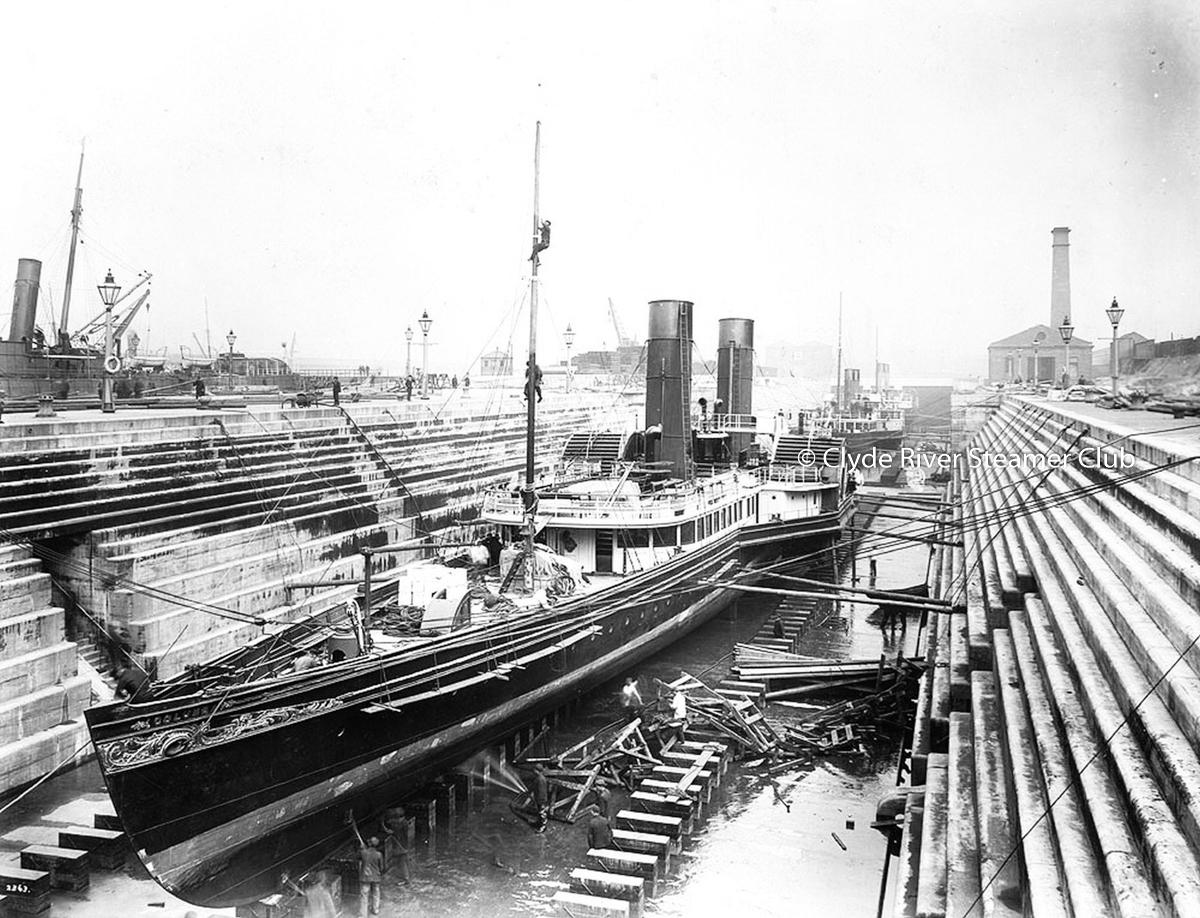
In May 1898 Govan No 3 dry dock was occupied by three MacBrayne steamers – Columba, Grenadier and Gael
Taking us back to the PS Columba on the props at Govan, and the 1890 Duchess of Hamilton at Lamont’s, we saw ships photographed from angles rarely seen. Only from these aspects can the depth of hulls, the shapes of sterns and the sheer size of rudders and propellers be appreciated. One incredible sequence showed the propeller being re-fitted using a spanner that would never have fitted into even John’s toolbox. It wasn’t just the ships, we almost had to look away at the images of soft-hatted workers standing atop thirty-foot high ladders, with no safety harness, re-painting a hull.
Some of John’s best photos were of ships in dock following collisions. The 1932 Duchess of Hamilton with a bent nose, the Minerva almost cut in half after an altercation with a Clan Line vessel on the Clyde, and further afield, a vessel of a type John was familiar with in foreign lands requiring considerable maxilla-facial surgery after being struck by a tanker. Such pictures made us wince!
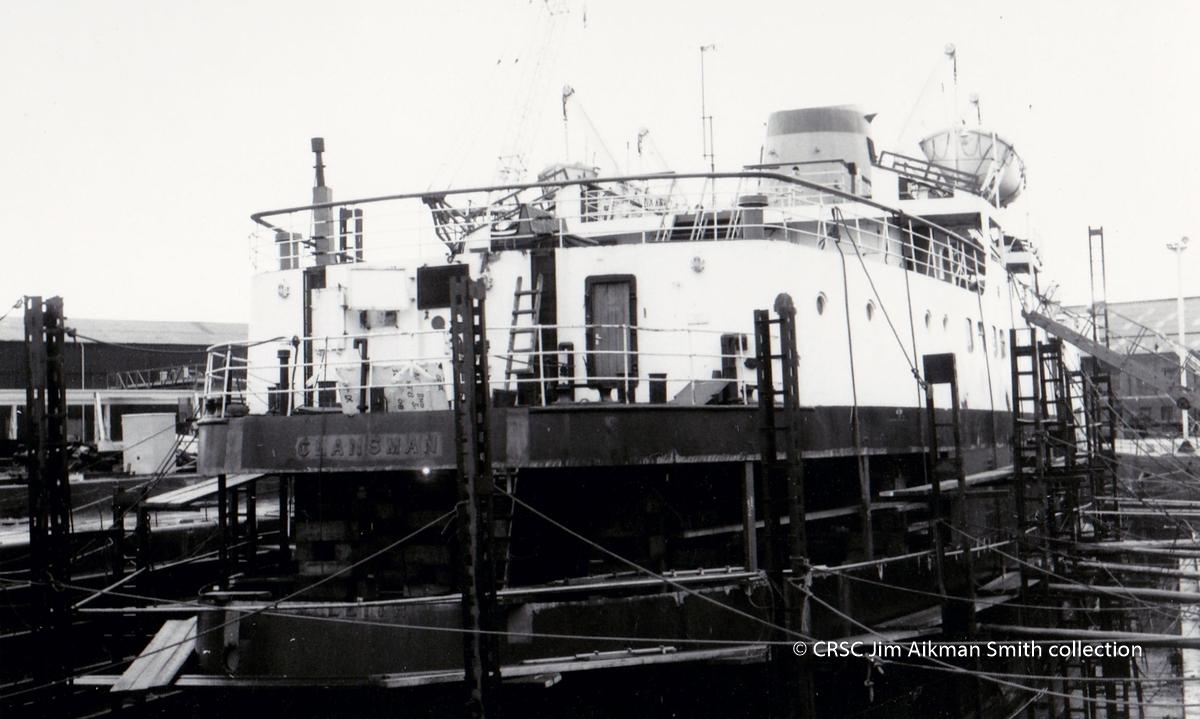
MacBrayne’s 1964 Clansman undergoing major surgery in drydock at Troon
Bringing us towards more recent times there were detailed examples of ships being lengthened, in a dry dock of course: the 1964 Clansman, Isle of Mull and, more recently, Graemsay and Hoy Head.
John finished by making a couple of interesting observations about dry docks. He reminded us that only a couple of decades ago one could have wandered into and around them with impunity; not nowadays! And he let us consider how redundant dry docks can become excellent sites for museums, such as HMS Victory at Portsmouth.
The number and sheer variety of photographs indicated just how much research, and timely visits to dry docks with a camera, had contributed to John’s presentation. It was very much enjoyed and appreciated by his audience, especially as he had stepped into the breech at short notice. It gave us an insight into the workings of these docks, and to the bits of ship anatomy that we rarely get to see. It was all quite riveting (sorry!) and one wonders what other gems John has stockpiled in his tool box for such evenings.
The club now looks forward to Gavin’s Presidential Address in the near future.
If you are a paid-up CRSC member, you can watch a video of John’s presentation here.
The next CRSC meeting is on Wednesday 14 January at 7pm in the Maldron Hotel, when Iain Quinn and Eric Schofield will celebrate ‘TSS King George V – five classic decades’.
Published on 18 December 2025