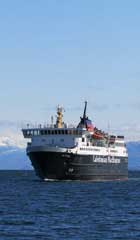
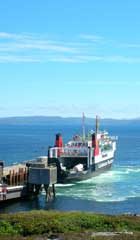
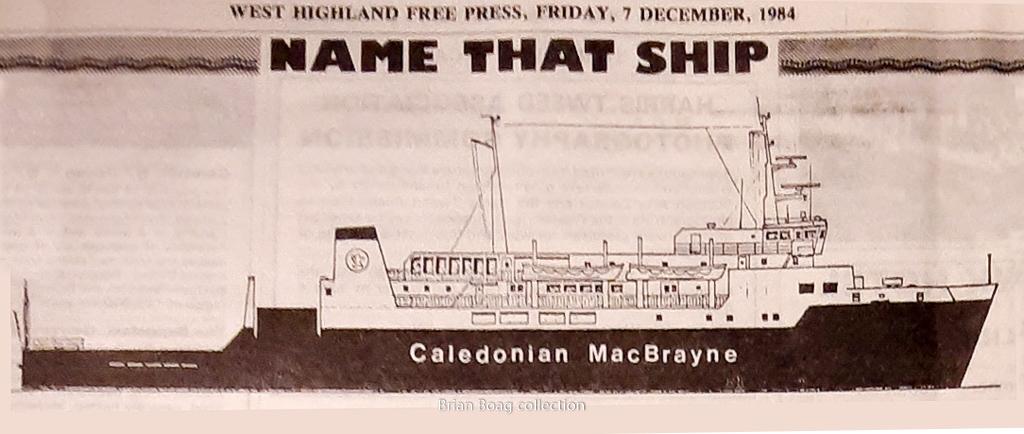
An artist’s impression of the new ship then being built by Cochrane’s of Selby for the Uig triangle
There was much speculation about the name of Yard no.130, building in Cochrane’s Shipbuilders, Selby, and destined for the ‘Uig triangle’ service. The Free Press reported that Caledonian MacBrayne’s Chief Executive, Colin S. Paterson had raised the possibility of naming the vessel ‘Lord of the Isles’.
The paper asked readers for views and suggestions and received no fewer than 120 responses with 57-plus suggested names.

By the early 1980s the 1964-built Hebrides, seen here at Tarbert, had become too small and a replacement ship was ordered from an English yard
Readers did not favour Paterson’s choice, though the name was used five years later for the vessel then launched at Appledore Ferguson, Port Glasgow. The Free Press reported that the name which seemed to gain the most support was ‘Islesman’. The wide range of suggestions however suggested that there was no consensus. Some continuity with the 1964 Hebrides gained support but as this vessel was still in service the name could not be used for the new build. ‘Hebridean’ had support as an alternative.
One correspondent proposed that, following the precedent of Queen Mary II, the 1964 vessel could be renamed ‘Hebrides II’, and the new build then get the name ‘Hebrides’. The published letters indicate that this would have been a popular choice but CalMac no doubt had good reasons for not doing this.
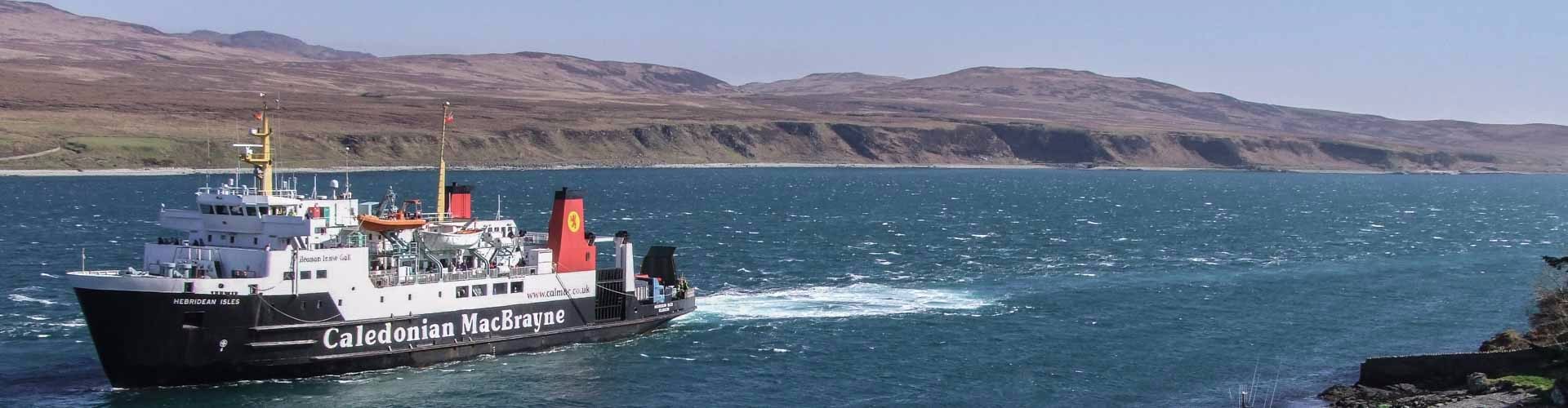
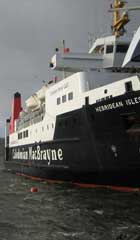
There was a lot of support for a Gaelic name but no consensus on what that should be. At least 14 Gaelic names were suggested by correspondents, the one with the most support being ‘An t-Eileanach’ (the Islander) and the next popular being ‘An Eala-Bhan’ (the White Swan). CalMac did not adopt a Gaelic name but perhaps the level of support shown on this occasion played a part on the later adoption of Gaelic versions of the names on the ship’s sides as seen today. Hebridean Isles was ‘Eileanan Innse Gall’.
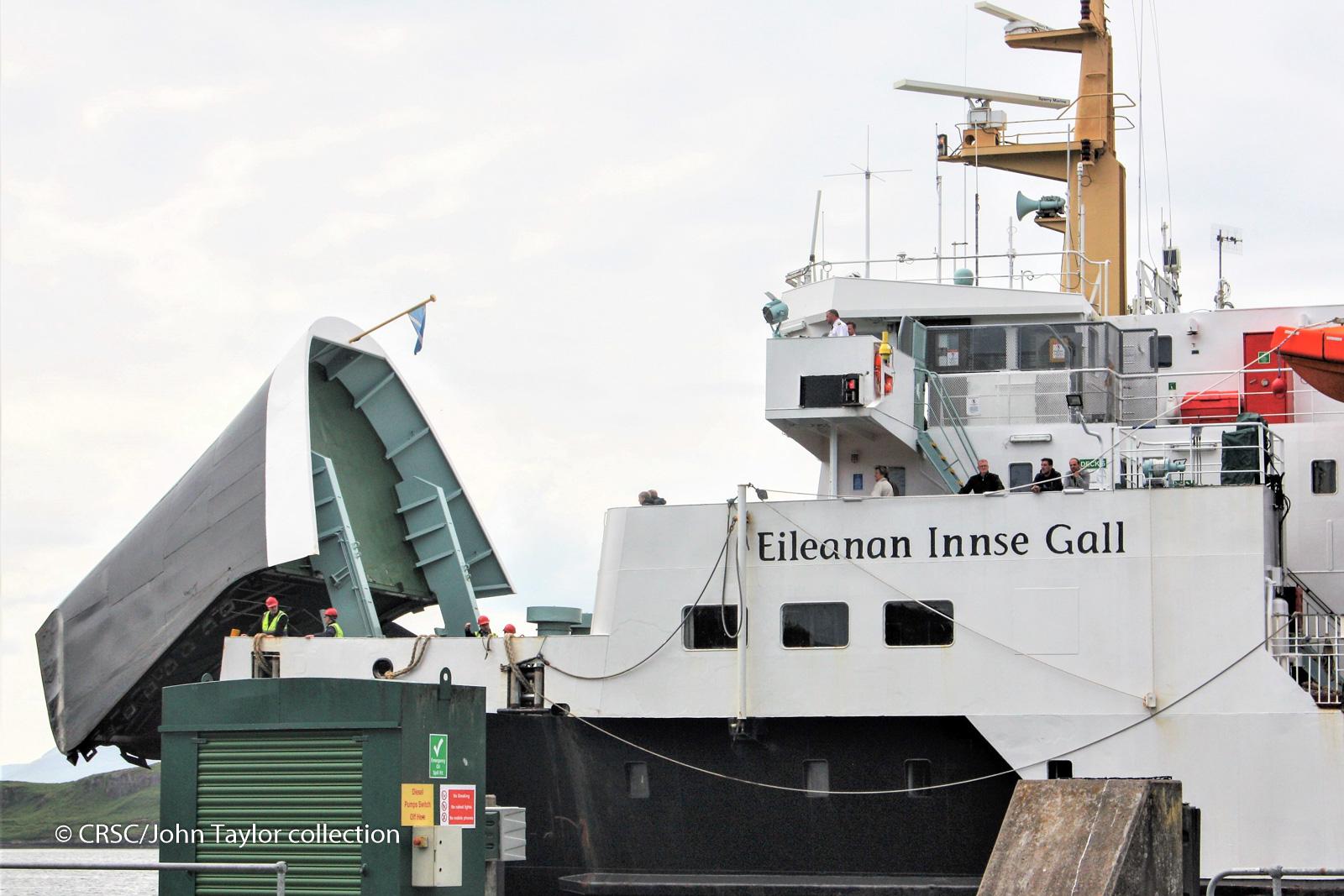
‘Eileanan Innse Gall’ – the Gaelic name later bestowed on Hebridean Isles
Some correspondents favoured a traditional steamer name with ‘Gael’, ‘Plover’, ‘Dunara Castle’ and ‘Caledonia’ proposed, along with ‘Chieftain’ and ‘Loch Seaforth’, the last two happily re-appearing in later years.
Geographical names gained a lot of support. ‘Clisham’ was the most popular of these following the place-name model of Suilven. Other ideas included ‘Loch Snizort’, and the somewhat partisan proposals of ‘Uists’, ‘Isle of Harris’ and ‘Isle of Skye’.
These options revealed the tricky complication with the ‘Isle’ style of nomenclature adopted in the 1980s for the larger vessels.
Individual names were offered – ‘Flora MacDonald’ was one, ‘Bonnie Prince Charlie’ another.
A lot of one-off options were suggested. For example, ‘Ebudae’, which was apparently what the Romans called the islands. Perhaps ‘the Eb’ would have caught on! CalMac could have chosen from ‘Minch Monarch’, ‘Minch Queen’, ‘Pride of the Isles’, ‘Island Queen’, ‘Sea Eagle’, and others. The prize for the worst idea must go to – ‘Triangular Queen’!
Some correspondents came close, with ‘Hebridean Highway’, or ‘Hebridean Princess’, a name used for the ex-Columba after 1988. But not one suggested ‘Hebridean Isles’.
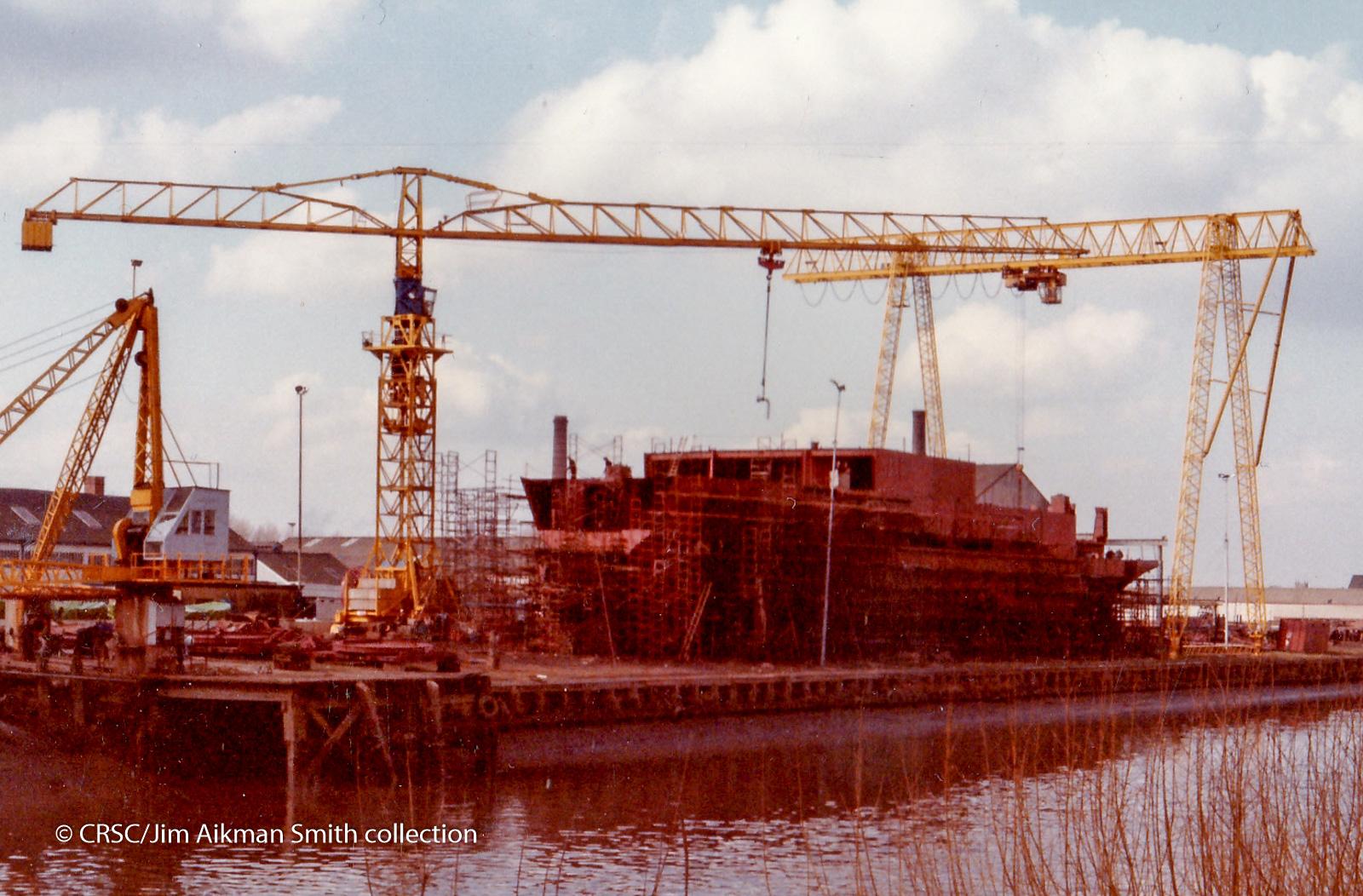
Yet to be named, Cochrane Shipbuilders’ yard number 130 takes shape on the banks of the River Ouse at Selby in Yorkshire
Overall, CalMac surely got it right with a name that turned out to be very appropriate for the 39 years of service which gained the affection of the travelling public, who often to her as the ‘Heb Isles’.
The Free Press sent all the letters and proposals to CalMac for consideration. This exercise illustrated the level of public interest in the naming of vessels and might also help to explain why CMAL in more recent years have invited public votes, but for restricted lists of given names.
Although living in Inverness, Brian Boag has been a member of CRSC for many years. Have you joined this friendly association of ship enthusiasts? Click here for your £15 introductory membership and you’ll get all the benefits, including CRSC’s highly prized colour magazine, an annual Review of west coast shipping and exclusive access to photo-rich ‘members only’ posts on this website.
Published on 21 January 2026