
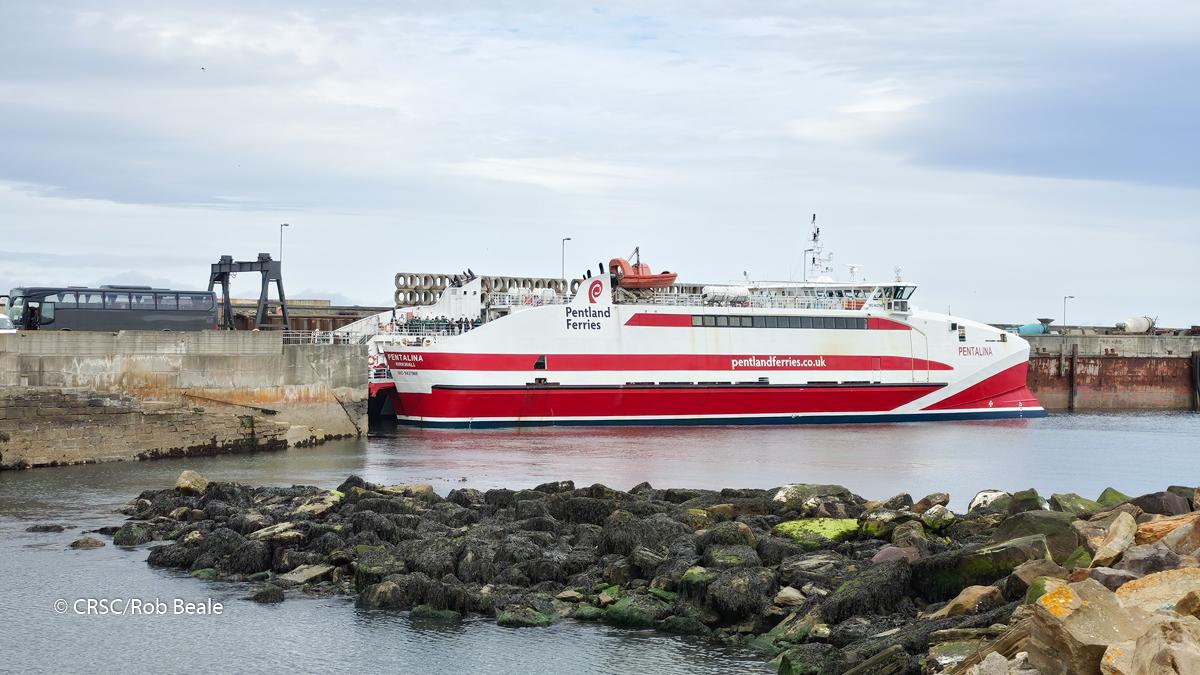
Pentland Ferries’ first catamaran car ferry Pentalina berthed at Gills Bay
Part One: Getting There
Rob Beale is well known to folk in the Lake District, where he is a skipper with Windermere Lake Cruises. Enthusiastic about all forms of water-based transport, he has recently returned from a holiday with his family in the Orkneys.
Back in 2004, at the youthful age of 16, a friend and I spent ten days on a holiday cycling around Orkney. We sailed on Hamnavoe from Scrabster, spent our time visiting most of the islands and travelling on most of the Orkney Ferries fleet, and then departed from Hatston Pier on Hjaltland back to Aberdeen.
Since then I have always maintained an interest in the shipping of this northern archipelago and planned a holiday to revisit during 2020. For obvious reasons that had to be cancelled, and it wasn’t until 2026 that I had the opportunity to visit again.
Now, with my wife, three kids and a dog in tow, my aims were slightly different to those of 2004, and much more family orientated. However, my wife likes a lie-in while on holiday, and so I devised a plan to visit every Orkney ferry terminal, except one, and to sail on every active fleet member during our week in the isles.
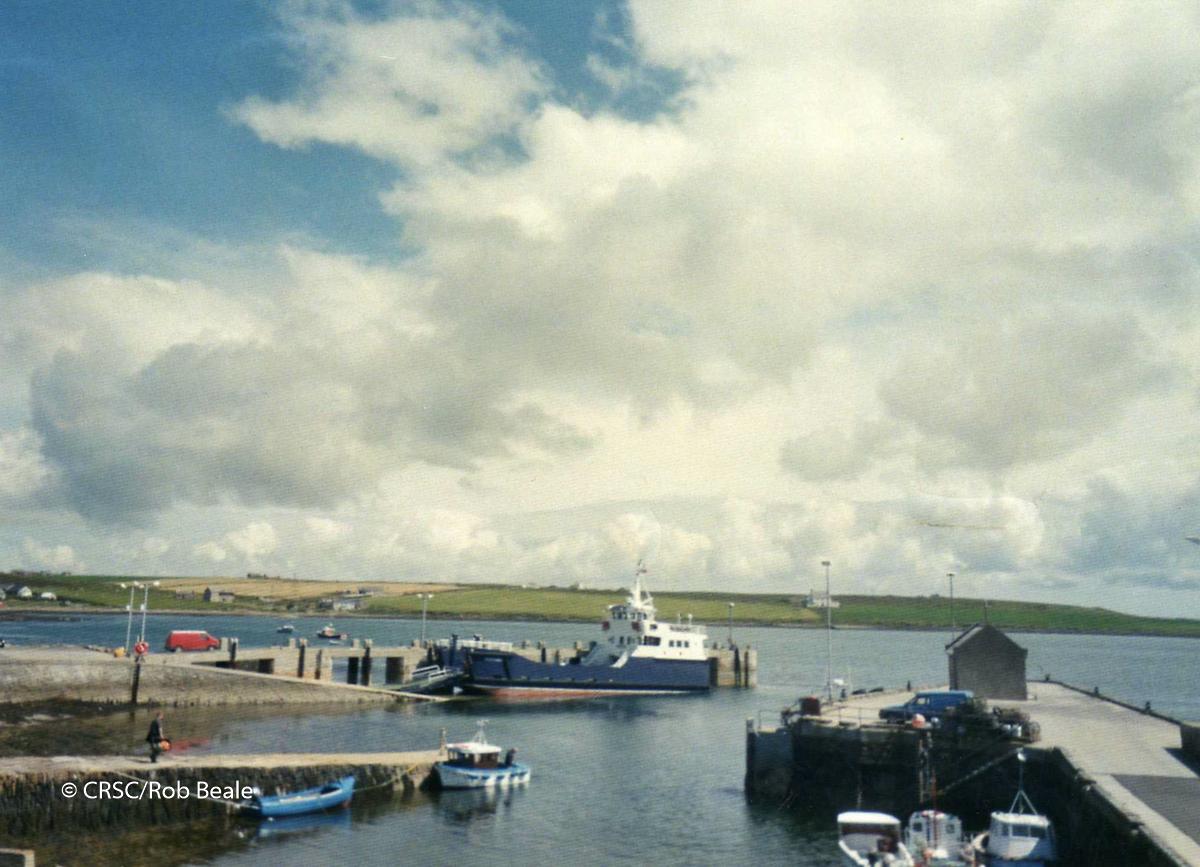
One of Rob Beale’s aims during his family holiday was to improve on the quality of pictures he had taken in 2004 using a disposable camera, including this one of Shapinsay at Balfour
Two things had always bothered me about my 2004 visit: I had sailed three times aboard Earl Thorfinn, but had not managed to sail on her sister vessel, Earl Sigurd. And back then I only had a cheap disposable camera, so the few photos that I had taken were of terrible quality.
With the announcement from Orkney Ferries that the North Isles boats are earmarked for replacement soon – tenders will hopefully be awarded during the summer of 2026 – I planned a trip to enjoy sailing on the ‘Earls’ and to take pictures of the fleet in different locations.
On my previous visit, my friend and I took advantage of Orkney Ferries’ Sunday excursion schedule and spent five hours exploring North Ronaldsay. That would not be possible for me in 2026, as the excursions were not due to commence until the week following my visit, but I still wanted to sail on the unique ‘lift-on, lift-off’ (Lo-Lo) route to Papa Westray or North Ronaldsay (or both). My plan for the week began to take shape around this, but I still had to work out how to get to Orkney in the first place.
Living in the Lake District, sailing to Orkney from Aberdeen would seem to be an obvious choice. On a visit to the Shetland Islands a few years ago I had sailed that way, making sure I travelled on both Northlink ships, but this time I looked at sailing across the Pentland Firth.
Having enjoyed sailing to Brodick on Pentland Ferries’ Alfred from Ardrossan, and also Troon, I decided to head to the islands from Gills Bay on her older sister vessel Pentalina. I booked the sailing many months in advance, keeping one eye on the CalMac disruptions, and secretly hoping that Alfred’s charter would be extended and she would stay on the Clyde. Less than a week before our holiday was due to start, Alfred’s spell with CalMac was extended until mid-October, meaning Pentalina would remain in service at Orkney.
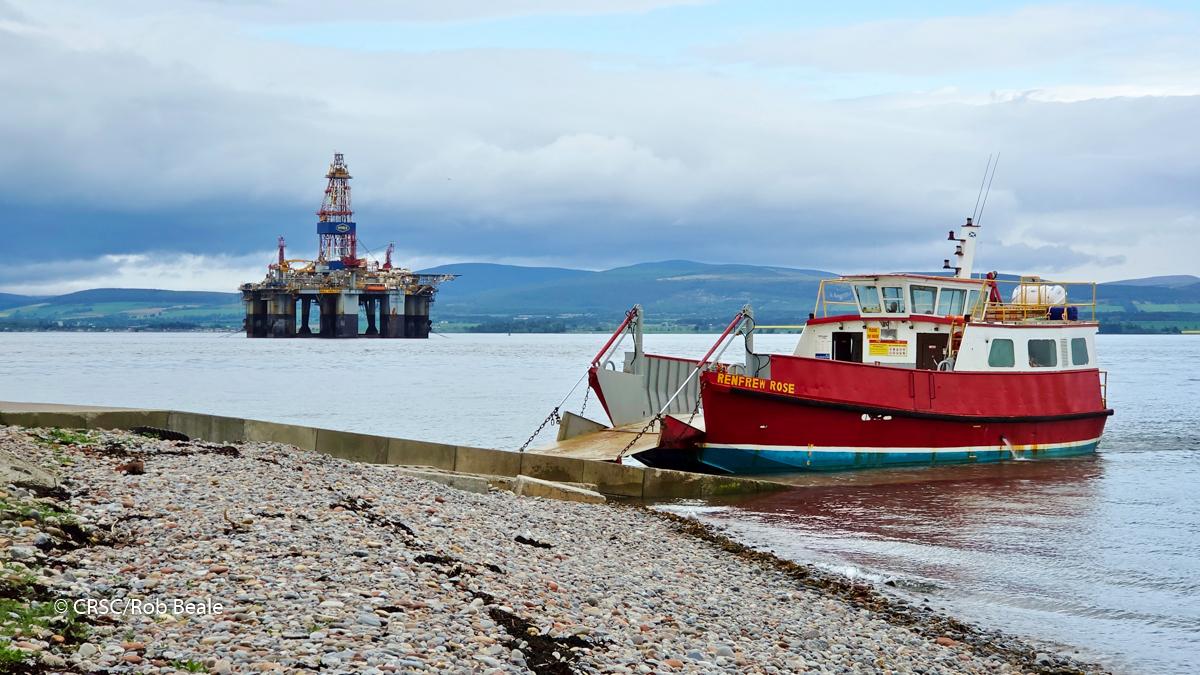
A short detour from the journey north allowed for a quick trip on the former Renfrew-Yoker ferry Renfrew Rose
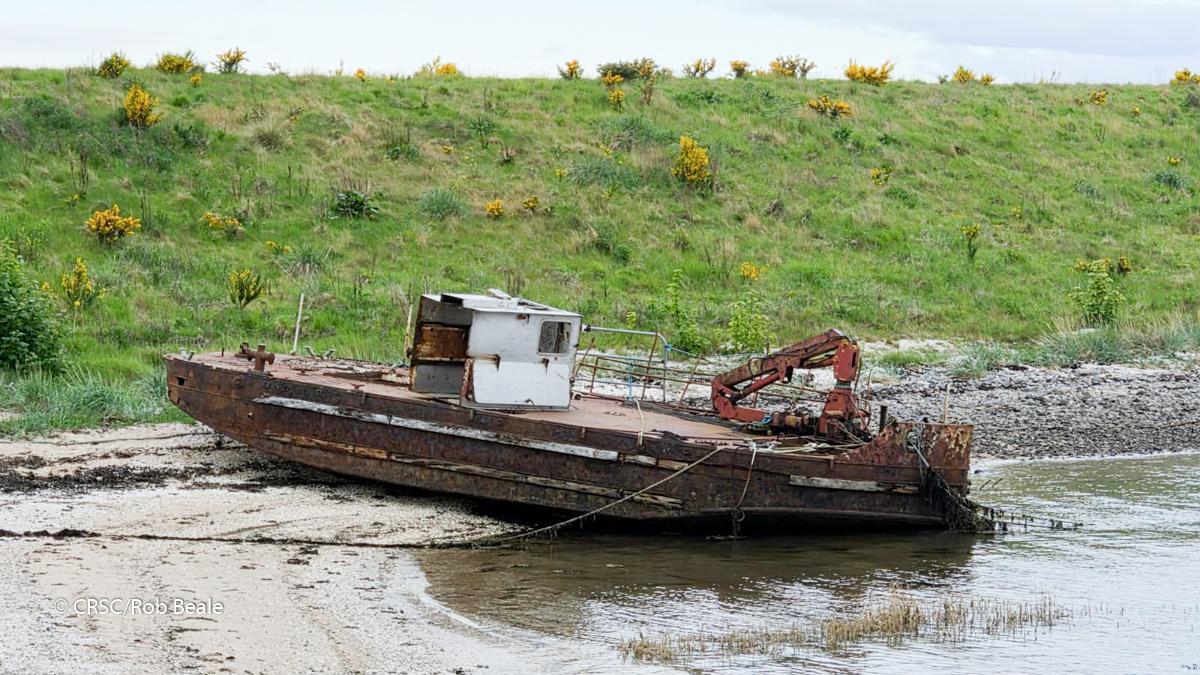
The beached hulk of former CSP Kyleakin ferry Lochalsh at Nigg; after serving at Skye she was a workboat on the Caledonian Canal for a time
And so, at the start of the English May half-term school holiday, we drove north from Kendal, breaking our journey by stopping overnight near Invergordon. This was just a very convenient spot, and nothing at all to do with being in close proximity to the Cromarty – Nigg ferry. As it was so near, we took a quick crossing on Renfrew Rose and also found the nearby wreck of an old Skye turntable ferry just north of Nigg.
On the Monday morning the drive ever further north continued, and we reached Gills Bay at around 12:30, in ample time to check in for Pentalina’s 13:30 sailing to St Margaret’s Hope on South Ronaldsay. Our car was the third or fourth vehicle in the queue, and as more and more vehicles turned up behind us, I wondered how the incoming vehicles would manage to depart, as the only road out from the terminal now resembled a car park. About five minutes before Pentalina arrived and turned to berth stern in, a few traffic cones were removed, allowing us and the other cars, coaches and a couple of lorries to make our way into the loading lanes. We were among the first vehicles to board, driving up the port side of the vessel, crossing near the bow, and parking facing aft along the starboard side. Once this side was filled, the coaches and lorries reversed on, and finally the remaining cars filled the port side.
Although we were safely on board by 13:15, for some reason we departed around 20 minutes late, at 13:50, to that regular ‘musical’ accompaniment heard on many Scottish ferries – the constant sound of car alarms going off!
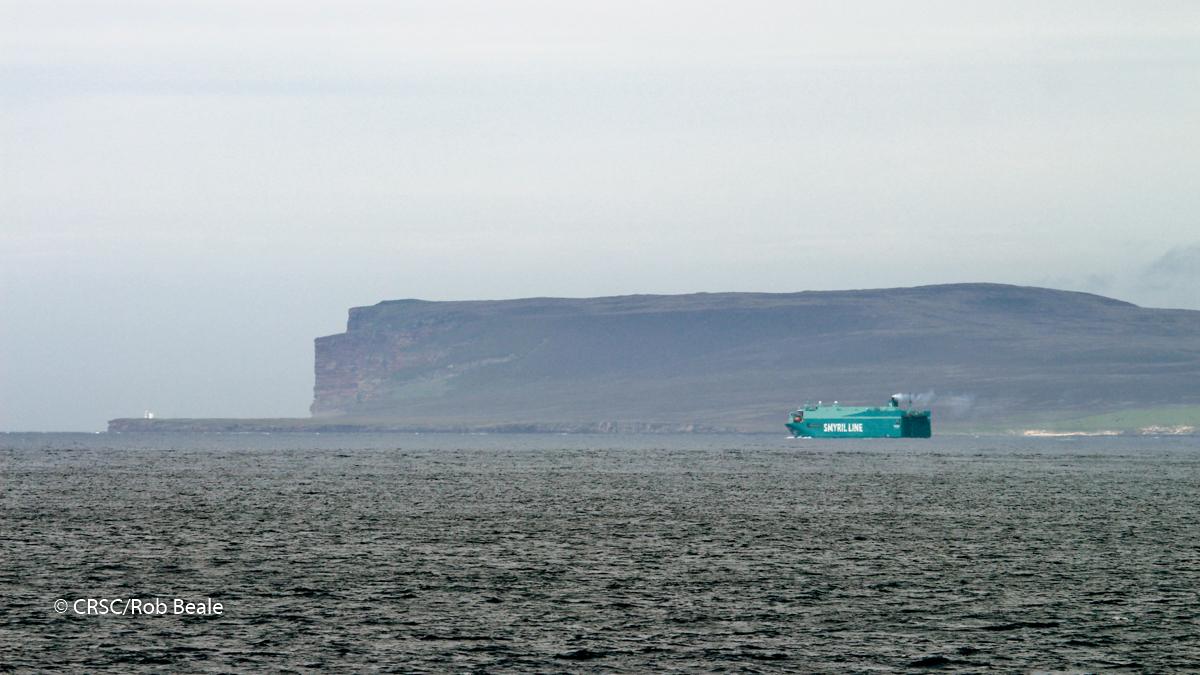
Smyril Line’s freighter Mykines on her way to Tórshavn from Rotterdam
As I expected, Pentalina is a smaller version of Alfred with passenger accommodation laid out on each side. She does not have the large sun lounge behind the wheelhouse. Instead, she has a walkway on the upper deck between the two sides, or a corridor on the lower deck providing access between the port and starboard lounges.
The sailing took us up the west side of Stroma – an island I have long wanted to visit due to its relatively recent abandonment. Beyond Stroma we passed Swona and cruised astern of Mykines, a Smyril Line cargo vessel that sails weekly between Rotterdam (Netherlands), Tórshavn (Faroe Islands) and Torlakshöfn (Iceland). Unlike her counterpart on the Clyde, Pentalina does offer catering, supplying us with lovely bacon rolls for lunch and a decent soup.
St Margaret’s Hope was reached at 15:00, and we were ashore less than five minutes later. I drove us to our accommodation, about half an hour away, overlooking Scapa Flow and close to the South Isles ferry terminal at Houton.