

Cameron Marshall at one of CRSC’s winter meetings
Cameron Marshall discovered the CRSC on Saturday 17th of September 1966 aboard Maid of Argyll, on charter to the Club and making the last passenger sailing from Paisley Harbour. He was nine years old. “My Mum had seen the sailing advertised in the Paisley Daily Express, and knew that I would be excited beyond words. On board, she asked Ian McCrorie if a child could join the Club. He signed me up there and then, as the ‘Maid’ made her whiny, vibrating progress down the Clyde. I think I was the youngest member for quite a few years. My Dad took me to the club meetings at Strathclyde University that Winter – they seemed very serious and quite formal. Later, I used to travel up from Ayr with Peter Milne, who was head of Classics at Ayr Academy. I always had a CRSC badge on my school blazer and was always happy to explain what C.R.S.C. stood for.”
Douglas McGowan hired Cameron as one of Waverley’s Assistant Pursers for her first WSN season, 1975. The wage was £5 per week. He was then appointed Chief Purser for 1976. “All eyes were on Waverley,” says Cameron, “and all of us in the Ticket Office were so determined to be just as professional and much more friendly than our erstwhile and more senior rivals on Queen Mary.”

A youthful Cameron Marshall (at the gangway, below the deck light) on board Waverley on 22 May 1975 for her inaugural sailing under preservation from Glasgow. Terry Sylvester is addressing the assembled passengers as Peter Reid and Douglas McGowan (in dark sunglasses) look on. Cameron’s name would later join theirs on the rolls of directors of the Waverley company boards
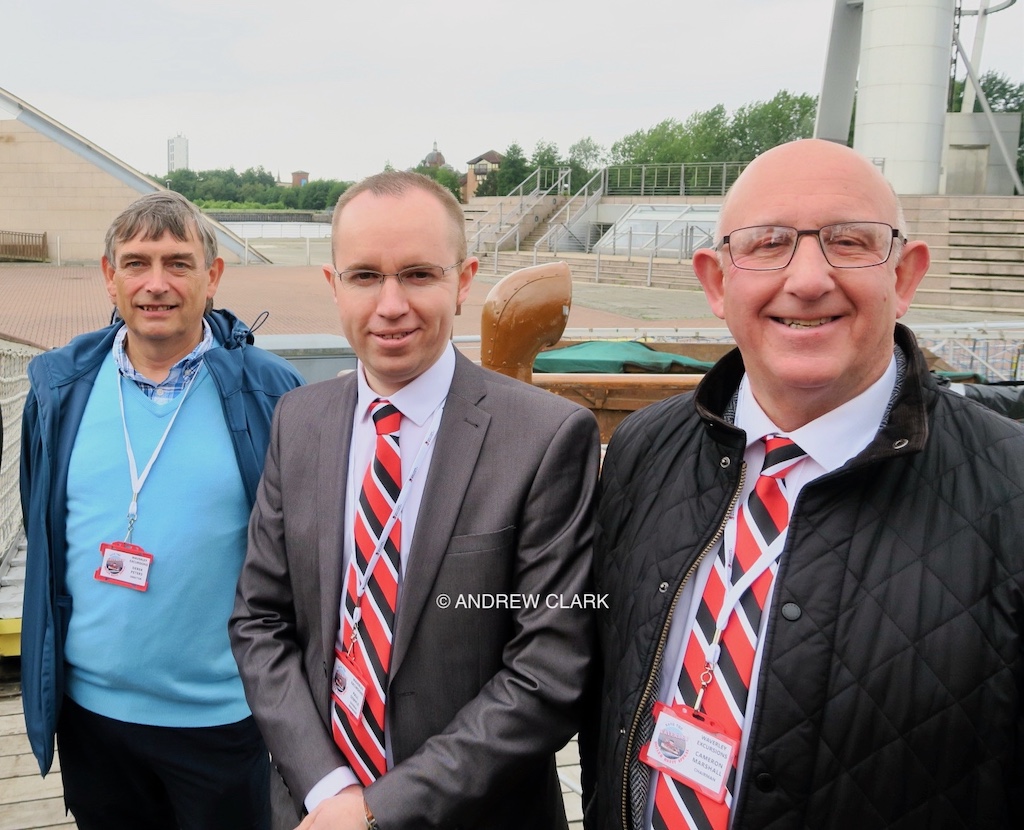
Cameron Marshall (right) with fellow WEL director Derek Peters and WSN general manager Paul Semple at the launch of the £2.3m Waverley Boiler Appeal in June 2019
His last day working on Waverley was 15th July 1977, when he relates that the pursers counted 620 passengers off Waverley on the Gantocks and onto Sound of Shuna.
Fast-forward half a lifetime, and Cameron joined the Board of Waverley Excursions after his retirement from corporate life in 2013. When most of the Board resigned late in 2018, he stepped in as Chairman, and helped bring stability and continuity to the operation at a tricky moment.
One of his first actions was to propose Paul Semple as the new General Manager. And the rest, as they say, is history. Now Cameron answers Stuart Craig’s questions as he is put ‘On the Spot’.
What is your earliest memory of sailing on a steamer or ferry?

The ‘wee ferry’ Leven sets out from Largs on a fresh June day in 1959
My grandparents retired to a seafront flat in Millport when I was three, so all my early steamer memories are Millport-centric. I remember travelling from Paisley Gilmour Street to take the Talisman to Millport from Wemyss Bay via Largs. I got a Beezer comic at Menzies on the platform. We’d go down to the cafeteria after leaving Wemyss Bay for juice and a sugary doughring, and come back on deck before Largs. I loved the ‘wee ferries’ Ashton and Leven too, especially on a stormy day, heaving round Farland Point. I was allowed to stand on the raised step beside the tiny wheelhouse to get a better view, and got soaked when they took a wave. It was pretty much the pinnacle of pre-school excitement. Standing on the exposed steering wires on the little lower deck at the stern to see if I could disrupt or change the direction of travel is an early memory of naughtiness.
What was the last sailing you took?
Across to Cumbrae on the Loch Tarbert and return on the Loch Shira. I still miss the thrill of arrival at the Old Pier, but never get tired of visiting Cumbrae. My last sailing on a ‘proper’ ship was Waverley to Tarbert earlier this year. Ayr to Tarbert via Millport, Rothesay and the Kyles used to be my favourite day when I worked on Waverley.
Where would you put Caledonian Isles?
Ideally I’d order two more new ferries and put her up for sale as soon as possible. Sentiment aside, worn-out ferries in their 4th decade or more are good for no-one, as we see again and again. I also wonder whether the ‘Glen’ sisters are not a bit too big for Arran. The size and capacity requirement seems to be driven by summer day-trip car demand, which is in turn driven by car ‘tourist’ fares that are arguably too low. A couple of right-sized new Schneider-propelled vessels which could get in and out of Ardrossan quickly might be a better solution than the ‘Sannox’, which seems to be proving quite well-suited for longer, Hebridean crossings. So why not keep ‘Caley Isles’ where she was built for a bit longer?
Do you have a favourite ferry or steamer?
Duchess of Hamilton, no contest. No other Clyde steamer I’ve sailed on even comes close (I never sailed on the ‘Montrose’).
What was the appeal? Silhouette; speed; space; silence; sea-keeping; superiority. For me, her funnels had an elegance that the ‘Montrose’ and ‘QMII’ just lacked. It felt as if you were boarding a greyhound of a ship, even though by my time she rarely did much over 16 knots. But what an effortless 16 knots! Not as much outright space as Queen Mary II, of course. Nowadays we’re too polite to say that ‘QM’ is a bit of a tub, but those who can remember rolling down (and back up) the Kilbrannan Sound on ‘QM’ in contrast to the forward-going battleship-like heave of the ‘Duchess’ will remember the difference.
Fraser MacHaffie once told me that the ‘Hamilton’ was perhaps not the happiest ship — always looking over her shoulder to check that nothing was gaining on her. Well, as a young enthusiast, that was just fine with me! My family moved to Ayr in 1967, and sometimes we travelled on the ‘Duchess’ from Ayr to Keppel via Brodick on a Friday afternoon. I was finishing first year at Ayr Academy in 1970, her last season, and could walk down on Friday lunchtimes to see her alongside, and after the 4pm school bell to watch her leave. I managed to get on board her hulk one last time when she was alongside at Troon, ready to be broken up. I have never felt more emotional about the loss of a non-living thing. I suppose the shrinks would say it’s end of that part of your life that you’re mourning.
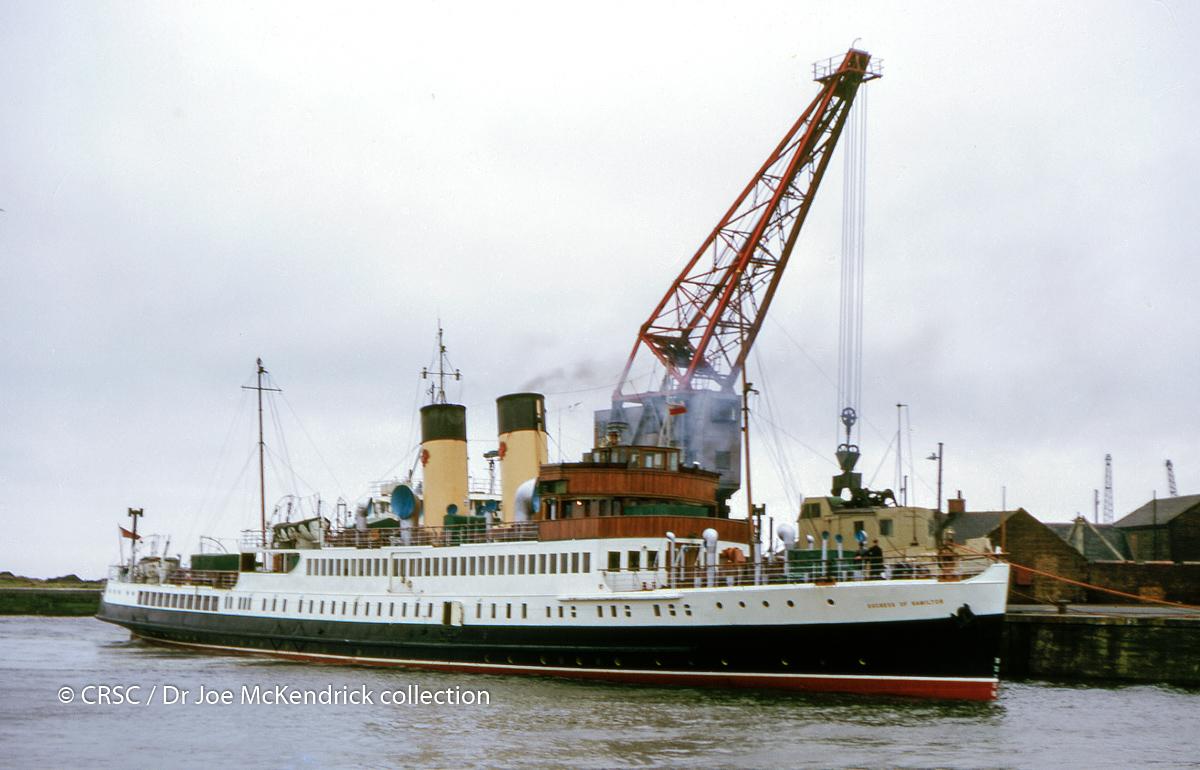
Seen on an early season visit, Cameron Marshall’s favourite steamer Duchess of Hamilton manoeuvring in Ayr Harbour in May 1970
If Queen Mary were to return to operation, how would you utilise her?
I’d rather avoid this question. I have great respect for those (including Calum Bryce, a fellow former Waverley Purser) who saved ‘QM’ from a sad end and brought her home. And I’m not aware of what’s happening with ‘QM’ at present. It’s just not obvious to me how a ship of that age and capacity and complexity could be reintroduced to UK coastal cruising. I worry that perhaps an excellent static preservation plan is being distracted by the grail of making her operational again. I have some insight from Waverley into the sheer level of regulatory challenge that attends the operation of old ships. If I had to make a stab, perhaps a market could be built for West Highland cruises from Oban and other ports at a much higher price point than Waverley offers. Queen Mary could be made very comfortable and very luxurious. But she was made for relatively fast day cruises. The luxury market is generally at quite a leisurely pace – we see Hebridean Princess pottering around at 10 or 12 knots and sometimes less.
I had a lump in my throat when I saw ‘QM’ from my bedroom window, being towed back up the Clyde. But I think it would bring a tear to my eye to see ‘QM’ dithering around at 12 knots. I was on her last sailing in 1977. A group of us stood gloomily on Largs Pier in the chilly evening as she sailed away. “That’s it,” said Iain MacArthur, “that’s it over.” Should we not settle very happily for the best static preservation possible, and perhaps hosting the Museum of the Clyde Steamers that is still so obviously lacking?
Which was your favourite ‘streaker’ and why?
Juno was my favourite — speed again! In 1976 we had a good few streaker races with Waverley leaving Dunoon northbound at the same timetabled moment. We could usually overhaul Jupiter long before Gourock, but Juno could almost hold her own with the paddler that summer. Her flying bridge looked smart from the offset, and initially gave her a starship look that Jupiter lacked until modified. It gets forgotten now how crude and grotesque it seemed to see Clyde ferries with their route painted in huge letters on their hulls.
A brand new paddle steamer is being built for Clyde service. What name would you give it?
For commercial success, a well-known name would be very useful, so I might just go for ‘Waverley’, if the current Waverley was in static preservation by that time. If it had to be a new name, ‘Flower of Scotland’ might catch some attention, though I don’t care much for the depressing tune! The enthusiast in me might go for ‘Columba’ or perhaps ‘Caledonia’.
Looking back, what is the perfect example of the Clyde Steamer or ferry?
The ‘Duchesses’ and their turbine predecessors really were pretty great. The story of the direct-drive turbine Clyde excursion steamer is one which risks being forgotten, even though I love the beat of paddles. The speed that could make a very comfortable day cruise from Gourock to Inveraray or Campbeltown or Ayr was a wonderful thing. In terms of pure aesthetics, a paddler with a single bow-wave that breaks just ahead of the paddle box is the perfection that one’s looking for. I read a long time ago that the 1895 Duchess of Rothesay, of all the paddlers, was as close to perfect as you can get in this respect.
What would you like to see happen on the Clyde or Hebridean ferry scene over the next few years?
I’d like to see a ferry network that is stable, efficient and cost-effective, which balances the needs of island residents and tourists with an acceptable and then capped level of taxpayer subsidy.
What’s the best point-to-point route you’ve sailed on?
Well I guess Hawaii to Vancouver non-stop in not really in the spirit of the question. And when I was in the University Royal Naval Unit (a long time ago) I once sailed aboard HMS Leander from Portsmouth to Gibraltar in severe gale force conditions. I love coastal scenery seen from a ship, but I love just being at sea even more. So to me Glasgow to Oban in a day on Waverley is pretty amazing. I remember when Campbeltown was the edge of the planet for Clyde Steamer trips, so rounding the Mull of Kintyre, paddling up the Sound of Jura or calling at Crinan are up there with my favourites. I lived away from Scotland for 35 years, and am still amazed and thrilled that such a passenger trip on a steamer can still actually happen.
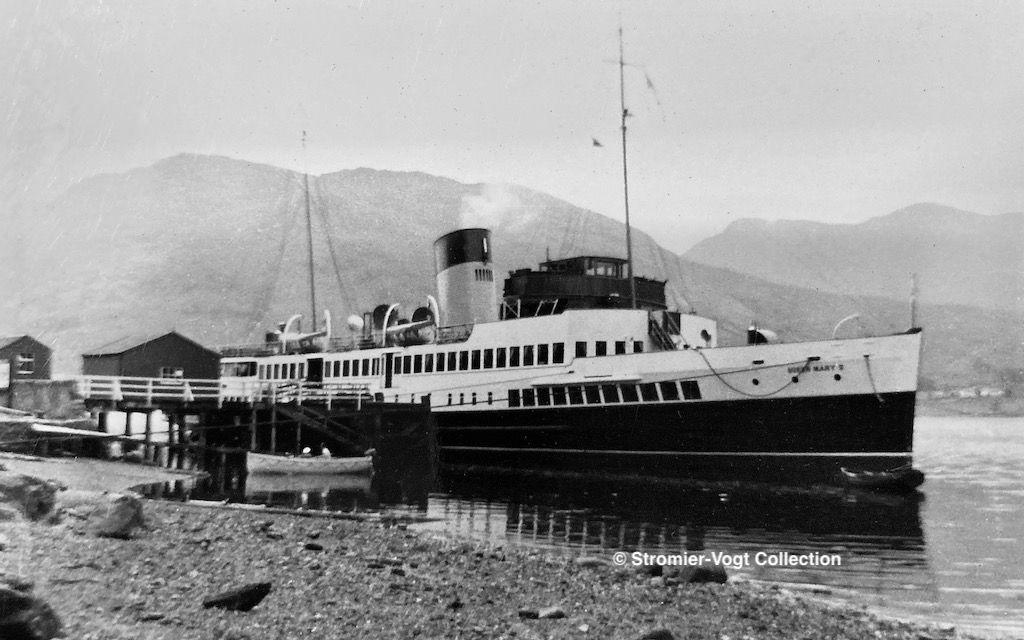
Queen Mary II on a rare visit to Lochgoilhead on charter in 1957
Which Clyde pier would you like to see re-open?
Does everyone think of Millport first, knowing now that can never happen? I have so many memories of watching steamers arrive there, viewed from my grandparent’s flat, from every possible point in the town, from the pier itself, from a small boat in the bay, from the Eileans. It would be a huge positive if Helensburgh became available to Waverley again, and if Tighnabruaich and Tarbert remain fully serviceable for years to come. Folk often mention Arrochar, though unless you are crossing to Tarbet for Loch Lomond, it’s more for the view across the loch than for going ashore. My fantasy pick would be Lochgoilhead, which was a short pier with very deep water. It’s a lovely place to walk. The image of Queen Mary II at Lochgoilhead I find very evocative.
What inspired you to join the CRSC, and how would you like the club to evolve over the next few years?
The joy of sailing, of being on a Clyde steamer or on any ship, and of being at sea. The geekery of studying timetables and learning steamer statistics. Gradually learning the bigger story of Clyde Steamers and putting that into its historical and social context. The aesthetic pleasure of simply beholding beautiful ships, watching them arrive and leave piers. The discovery at the age of 9 that there was a club with lots of other people who had a passion for these things too. Regarding evolution of the club in the next few years, I think perhaps the annual Review should be dropped. There should be a plan of how the images and other archive material that is in the club’s hands will be managed for the long term. I wish there was a dedicated Museum and Archive of the Clyde Steamers under one roof.
Cameron Marshall was one of the speakers at CRSC’s ‘Four Ships to Remember’ meeting in February 2024.Published on 29 July 2026